Content-Addressed Caching for Reactive Notebooks
A System for Cell-Level Cache Reuse in marimo
Abstract
We describe a caching mechanism for resumable sessions in marimo, a reactive Python notebook. Cache keys are derived recursively from the reactive DAG, content-addressing reference values and substituting parent-cell hashes where direct content addressing is not possible. The recurrence forms a Merkle structure that an edit invalidates at the subtree granularity. Cached values cross process and session boundaries through a lazy stub mechanism and participate in marimo’s static WASM/HTML export, so heavy computations and trained models can ship with a notebook to readers with a browser-embedded Python runtime. Empirically the cache lookup is as fast or faster than representative baselines on microbenchmarks of variably sized payloads. However, unlike other mechanisms, marimo’s caching is native to the reactive notebook, adds little user-facing overhead in its utilization, and allows for cross platform reuse.
Read it your way
The paper, live — the same notebook that builds the PDF, rendered with reactive marimo cells: drag the seed slider and watch the cache keys re-derive in your browser.
Paper (PDF) — the typeset proceedings version.
Demos — the capabilities of the cache, interactive.
Poster — presented at the SciPy 2026 poster session.
The one-figure version
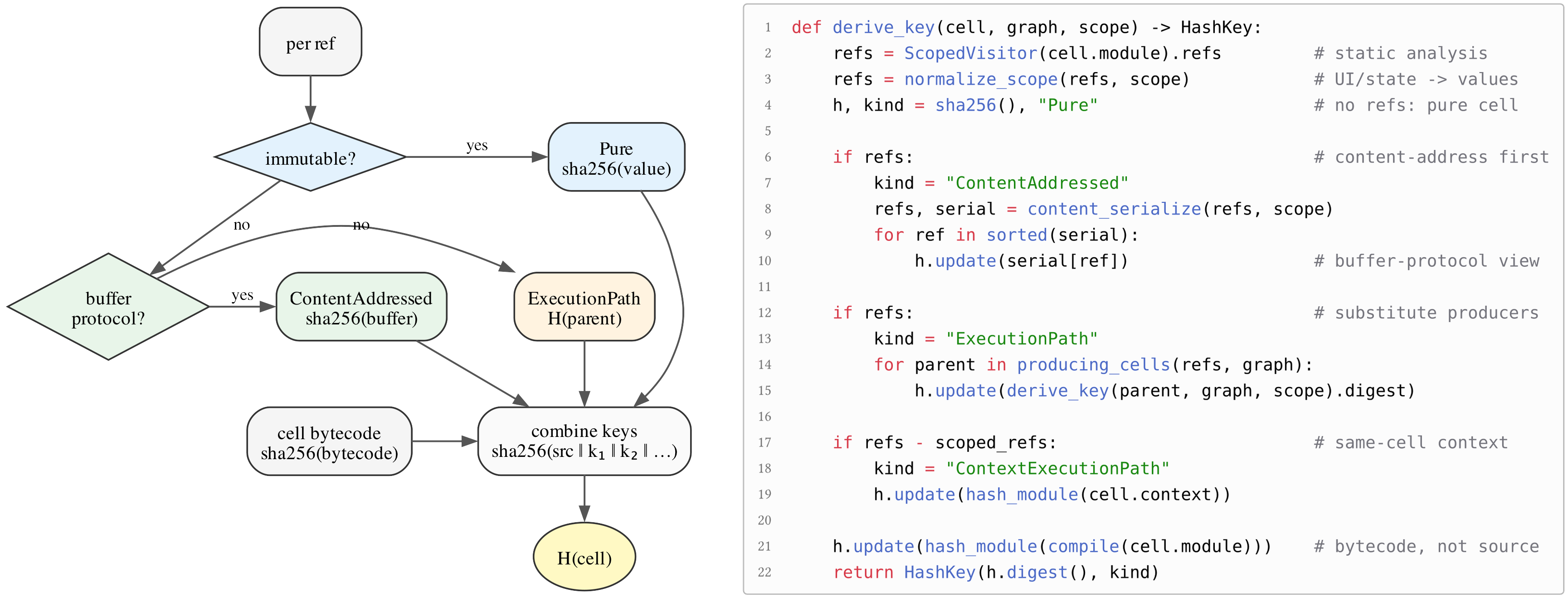
The cache key dispatch (left) and the derivation over a full cell (right): the same parse that schedules a cell yields its cache key.